Finding the right design agency: guide and decision matrix
Author: Matthias Wimmer · Published: October 9, 2025 · Updated: October 28, 2025
7 steps to finding the perfect design service provider
From agency size to range of services to comparing proposals: This guide takes you through 7 steps to selecting a design agency fairly and with thorough documentation, including criteria, key questions, and a free Excel matrix available for download.
Weigh criteria and compare offers fairly:
Table of contents
1. Before you start looking for an agency: 5 tips to save you time
When looking for a design service provider, many companies ask themselves, “What kind of agency is right for me?”
It’s not just about the size of the agency. Factors such as experience and interpersonal relationships play an important role.
You should clarify these points beforehand:
- What exactly is this about? What specific improvements should the project deliver? What outcomes are important (e.g., new website, brand foundation, landing pages)?
- How much can/are we willing to invest? What is a realistic budget range?
- Who is involved internally? Who provides input, and who makes the final decision? How many rounds of approval are realistic?
- When should the project be completed? Are there fixed deadlines (trade show, campaign, season)? What is a reasonable start and end date?
- What requirements must be met? Which points are mandatory? E.g., a specific CMS, accessibility, corporate fonts, internal tools.
Checklist
- Objective and Results
- Budget
- People Involved
- Dates and Milestones
- Requirements
2. Choosing the right type of agency
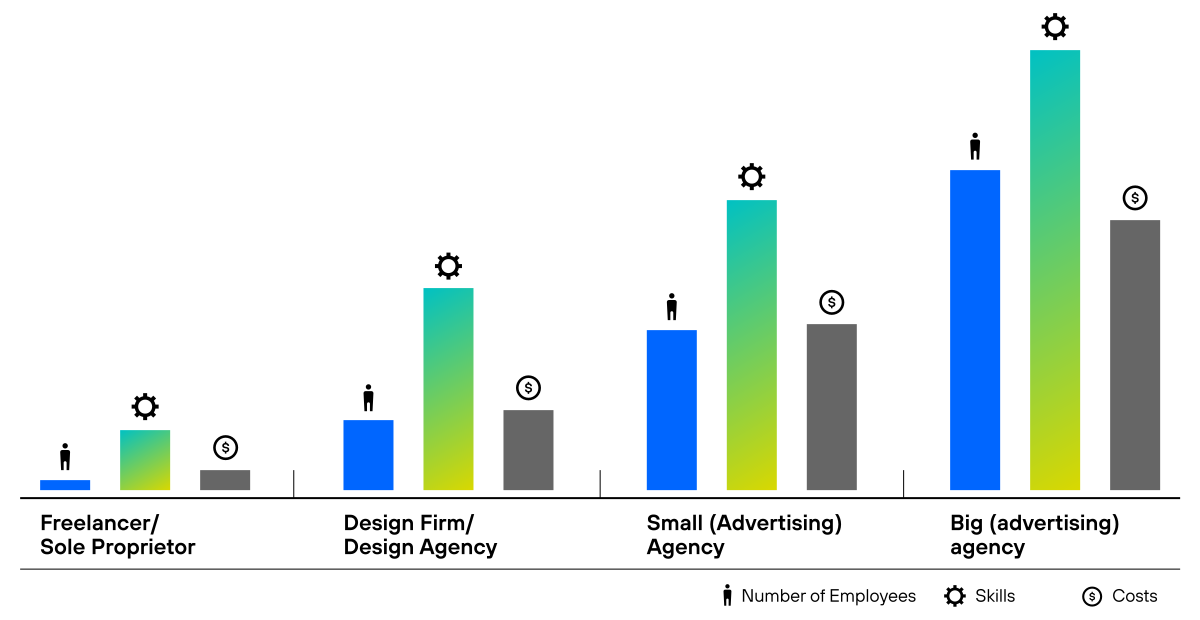
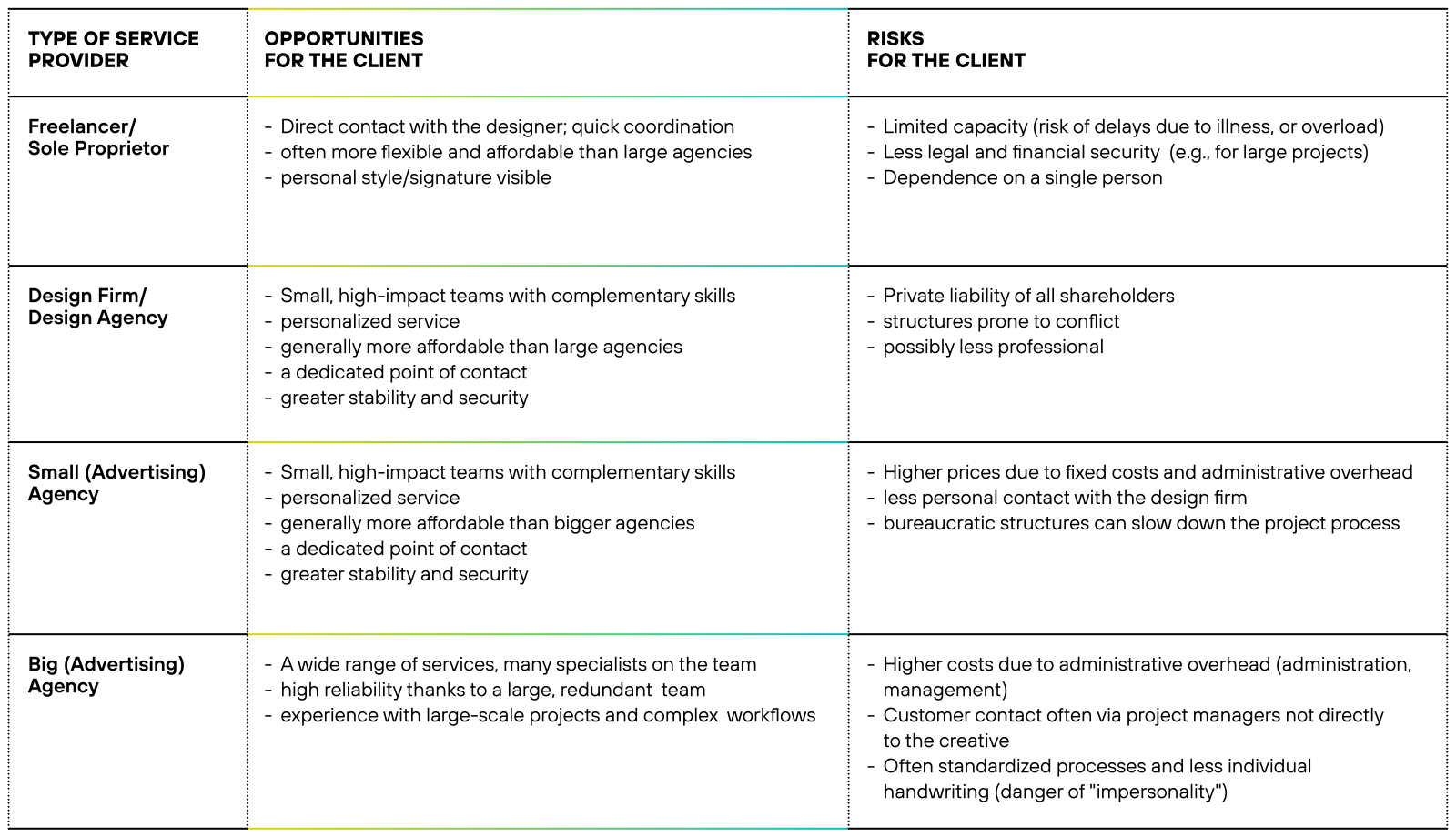
Project size, complexity, budget, and your preferred level of collaboration will determine which partner is right for you. Our overview highlights strengths and limitations, so you can see in just a few minutes which type of agency is the right fit.
Freelancer/sole proprietor
One person, specialized, flexible with a personal touch/style.
For small, clearly defined tasks with a personal touch.
Typical projects: Logo design, key visuals, individual layouts/modules, smaller web projects.
Strengths: Direct communication, quick decisions, often more affordable.
Limitations: Capacity and scope are naturally limited.
Suitable for: Smaller projects with clear requirements, individual style considerations.
Budget range: on the lower end (up to approx. €5,000).
Examples: Logo & basic elements for a small business; illustrations; individual page/module designs.
Challenges: Less multidisciplinary approach; bottlenecks possible with larger projects.
Design studio/small design agency
Small team (2–5 people), a combination of personalized consultation and creativity, high design standards.
For high-quality design and direct communication.
Typical projects: brand identity, rebranding, website planning, web design, brand guidelines.
Strengths: High-quality design, direct access to creative professionals, quick responses, long-term collaboration.
Limitations: Capacity may be too limited for very large projects.
Suitable for: Medium-sized projects where quality and speed are important.
Budget range: mid-range (approx. €5,000–50,000 depending on scope).
Examples: CD relaunch with guidelines; website concept & design; creative sub-campaigns.
Challenges: May face limitations when handling many sub-projects simultaneously plan milestones early on.
Small advertising agency
Often owner-managed (5–15 people).
Consulting and communication services from a single agency.
Typical projects: brand development, websites, advertising campaigns, content modules.
Strengths: Scope, predictable processes, dedicated points of contact.
Limitations: For extremely large or multi-stage projects, capacity will eventually reach its limits.
Suitable for: Growing companies that want strategy and support in addition to design.
Budget range: medium to high (approx. €50,000–200,000 depending on scope).
Examples: Brand strategy and advertising campaigns; online stores; integrated communication initiatives.
Challenges: Managing tight deadlines and scope changes effectively defining clear milestones and acceptance criteria.
Big advertising agency
Scalable teams for individual disciplines.
For very large, complex, or international projects with many stakeholders.
Strengths: Scalability, versatility, solid processes.
Limitations: Higher prices and more formal processes; with smaller budgets, there is a risk of relying on standard solutions.
Suitable for: Companies with large budgets and complex requirements across multiple channels and regions.
Budget range: higher (starting at ~€200,000 and up, depending on the program).
Examples: Global branding, integrated multichannel campaigns, international rollouts.
Challenges: Speed and spontaneity may suffer; less personal connection.
Our recommendation for startups and small and medium-sized businesses
For most projects at startups and small and medium-sized businesses, design studios or small design agencies are a good choice.
They offer the best balance of design quality, speed, proximity, and predictable services. Large agencies make sense when complexity and scalability are the top priorities.
- Direct line of communication: You speak directly with the people who will actually carry out the project.
- Speed & clarity: Short decision-making paths, quick approvals, fewer back-and-forths.
- Right-sized teams: Exactly the skills your project needs. No more, no less.
- Predictable quotes: Clear scope of work, defined milestones, transparent usage rights.
- Reliable handoff: Guidelines, files, access credentials. So your team can work independently.
Does that mean large agencies are “bad”? No. For international rollouts or extremely complex programs, they’re the right choice.
For most projects at startups and small and medium-sized businesses, however, a small design agency is the most efficient, effective, and personally pleasant solution.
Curious about how we work? Get to know our team and our range of services.
Our service portfolio provides an overview of the specific disciplines we offer.
3. Create an agency shortlist in 30 minutes
Seven criteria for choosing the right Agency
Before making initial contact: Check publicly available information.
The following seven criteria help determine who is truly a good fit in terms of goals, budget, and working style. This results in a solid shortlist for the next steps.
- Focus & expertise
Does the range of services (branding/brand identity/web design) align exactly with your project? - Substantive references
Are there comparable projects including the approach and results, not just pretty pictures? - Team & relevant experience
Who will actually be working on your project? Is there a designated point of contact and a clear chain of command? - Work process & timeline
How are revisions structured to ensure the project stays on budget and on schedule? What are the milestones?
- Clear proposals
Scope of services, number of revisions, usage rights, deadlines. Are they described clearly? - Availability & feedback
How quickly do you receive constructive feedback? How are decisions documented? - Post-launch support
Handover including brand guidelines, clean data, and support after go-live without dependencies.
From an overview to a shortlist: How to narrow down your options
A decision matrix makes the agency selection process comparable and transparent: First impressions are translated into criteria, weightings, and points. This allows you to see in just a few minutes which provider best aligns with your goals, budget, and working style.
Your decision is transparent, team-oriented, and well-reasoned. This reduces reliance on gut feeling and leads to a solid shortlist.
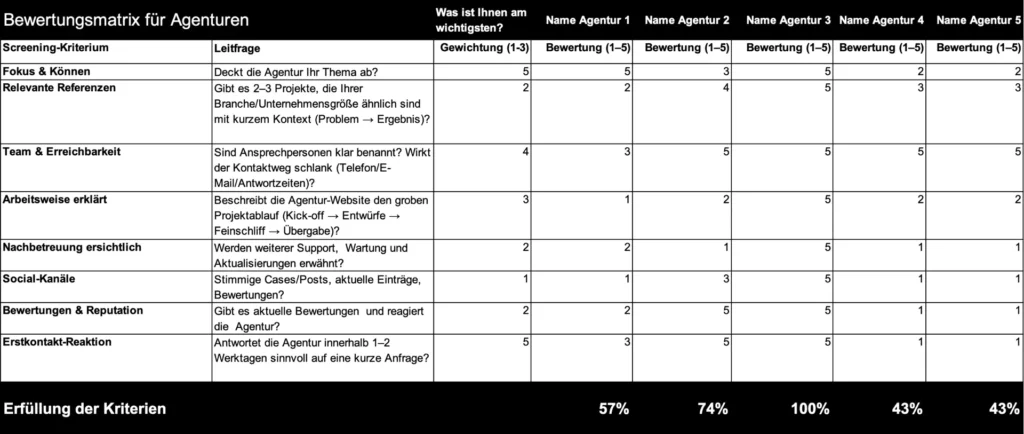
Here’s how to proceed: Find suitable agencies, rank the criteria by importance, and assign points to each provider. The spreadsheet will automatically calculate a weighted overall score (in %) based on this information. Weight criteria and compare offers fairly: Download the decision matrix (Excel, 12 KB).
4. Initial meeting with the agencies on your shortlist
Once you’ve narrowed down your list, contact the agencies and schedule a brief initial call.
Four answers are enough to decide whether to continue or eliminate a candidate:
- Who is working on our project?
- How does the process work and how do we keep it on schedule?
- What deliverables are required?
- When can we expect to see the results?
The answers to these questions quickly reveal whether there’s a good fit, both professionally and personally, and whether it’s worth requesting a quote.
12 Questions for the initial consultation
The following questions address factors that influence decision-makers when selecting an agency: availability, timeline, transparency, and quality.
- Who, specifically, is working on our project? (Roles, experience)
- Is there a designated point of contact and a backup?
- What similar projects have you completed (industry/scale)?
- How do you keep revisions to a minimum?
- What deliverables are included as standard (files, formats, brand guidelines)?
- How do you ensure consistency across channels?
- How do you handle changes?
- What timelines are realisti and what do they depend on?
- How are usage rights handled?
- How does the handover/training work?
- How do we stay within budget?
- How easy is it to reach you on a day-to-day basis?
Are you curious to read our answers?
5. Get quotes: fair and comparable
After the initial meetings, you now have 2–3 favorites. The next step: Obtain comparable quotes.
Use clear definitions of services and project requirements. Follow the structure below and ask the vendors to include it in their quotes.
1) Company, market, positioning
Who are you, who do you work for, and what do you stand for? Describe your industry, target audiences, core benefits/USP, and 2–3 relevant competitors.
Outline your brand’s tone and image (e.g., “clear, approachable, technical”) as well as the unique characteristics of your market.
2) Project requirements
What is the intended outcome and what impact should it have? Formulate goals and success criteria, and define the scope of services clearly and consistently so that proposals can be meaningfully compared:
- Scope of work (bill of materials): e.g., logo design (logo and logo variations), color and typography system, 10 application examples, brand guidelines (12 pages); For web projects: concept and design for up to X core pages, design and design system, handoff to development.
- Quality and scope criteria: e.g., 2 design directions, 3 motif/format variations, max. 6 core pages in web design.
- Exclusions: What is not included in the request (e.g., naming, photography, programming/online store, tracking).
- Desired collaboration process: 2 draft rounds + 1 final round (one round = consolidated feedback + revision); clear approval points for each milestone. Weekly 30–45-minute coordination meeting. Response time typically 1–2 business days; urgent cases: brief feedback on the same day.
- Usage rights: Specify media and duration (print, web, social media, trade shows; generally unlimited in terms of time and location).
- Delivery & acceptance: Milestones with acceptance (kick-off, drafts, finalization, delivery); list delivery contents (guidelines, editable files, export formats, access credentials), optional training/handover.
- Examples/no-gos: 1–2 references to guide the direction, plus things you do not want.
List existing content/assets (logo, colors, text, images) and technical requirements. Provide examples of best practices and things to avoid.
3) Organizational matters
- Who is the point person at your company, and who makes the decisions (core group, max. three people)?
- What is a realistic timeline (kickoff, drafts, finalization, handoff), and what is the feedback schedule?
- Optionally, please provide the planned budget as a range.
6. Comparing offers: Here’s what matters
A good proposal is more than just a number. Reputable agencies invest time in understanding your project and proposing an appropriate approach.
Therefore, don’t just compare prices also consider how well they understand your goals, the clarity of the scope of services, the realism of the timeline, and whether their working style suits you.
If something is unclear or doesn’t quite fit your situation, ask questions and request corresponding adjustments.
Most agencies see themselves as partners to their clients: Their goal is a win-win situation, which can only work with open communication. A brief clarification call, or, if two proposals are very similar, a small pilot project will quickly show whether the collaboration works both professionally and personally.
Contact & free initial consultation
Would you like to see if we’re a good fit for your project? Free 15-minute initial consultation by phone or video call. Based in Munich, with projects throughout the DACH region.

Matthias Wimmer
Graduate in Communication Design (University of Applied Sciences)
Master of Arts in Design
Through strategic design, creative ideas, and precise brand management, we create visual identities that raise a company’s profile.
7. Frequently asked questions about finding an agency
How can I tell if an agency is a good fit for my project?
Pay attention to their areas of expertise (branding/corporate identity/web design), comparable client projects, and who will actually be working on your project. A brief initial consultation with clear questions usually provides clarity in 15 minutes.
Freelancer, design studio, or large agency? Which option makes the most sense for us?
Freelancers are ideal for small, clearly defined tasks. Large agencies are worth considering for highly complex, international projects. For startups and small-to-medium-sized businesses, a design firm usually offers the best combination of quality, speed, and direct collaboration.
What drives costs, and how can I keep them under control?
Costs depend on the scope of work, the number of revision rounds, and the timeline. A clear briefing, prioritized tasks, and prompt feedback help keep the budget and schedule on track. You can find more information about design costs here.
How can I compare offers fairly when they’re structured differently?
Define four key factors: scope of services, number of revisions, usage rights, and timeline/deliverables. When these factors are listed side by side, price differences become immediately apparent.
Can we start small, for example, with a pilot project?
Yes. A compact starter package (e.g., a key visual and related applications, or the concept and design of a small website) allows you to test our collaboration, quality, and turnaround time with minimal risk.
How can I effectively check references?
Make a quick phone call and ask specific questions about availability, the schedule, change management, and any issues, not just about results. Two honest conversations are more informative than ten PDFs.
What are some typical “red flags” to watch out for in job offers?
Vague service descriptions, “unlimited” rounds without a clear process, no designated point of contact, unclear usage rights. If two or more of these issues arise, it’s better to clarify the details or keep looking.
More insights on this topic:
What is brand identity?
Definition and significance for your brand.
Learn more about brand identity here.
The brand identity process
How is a branding developed, and who is involved in the process?
Learn more about the brand identity process here.

How much does brand identity cost?
How much does it cost and what factors influence the cost?
Here you can learn more about the costs of brand identity.

Briefing for brand identity projects
Are you planning a brand identity project but aren’t sure exactly how to get started?
Take advantage of our brand identity briefing.
What are the benefits of brand identity?
Brand identity is an investment in your company’s financial success.
Here you can learn more about the benefits of brand identity.
Elements of brand identity
What exactly are the elements that make up a brand identity?
Learn more about the elements of brand identity here.